Google PPC
 February 23, 2026
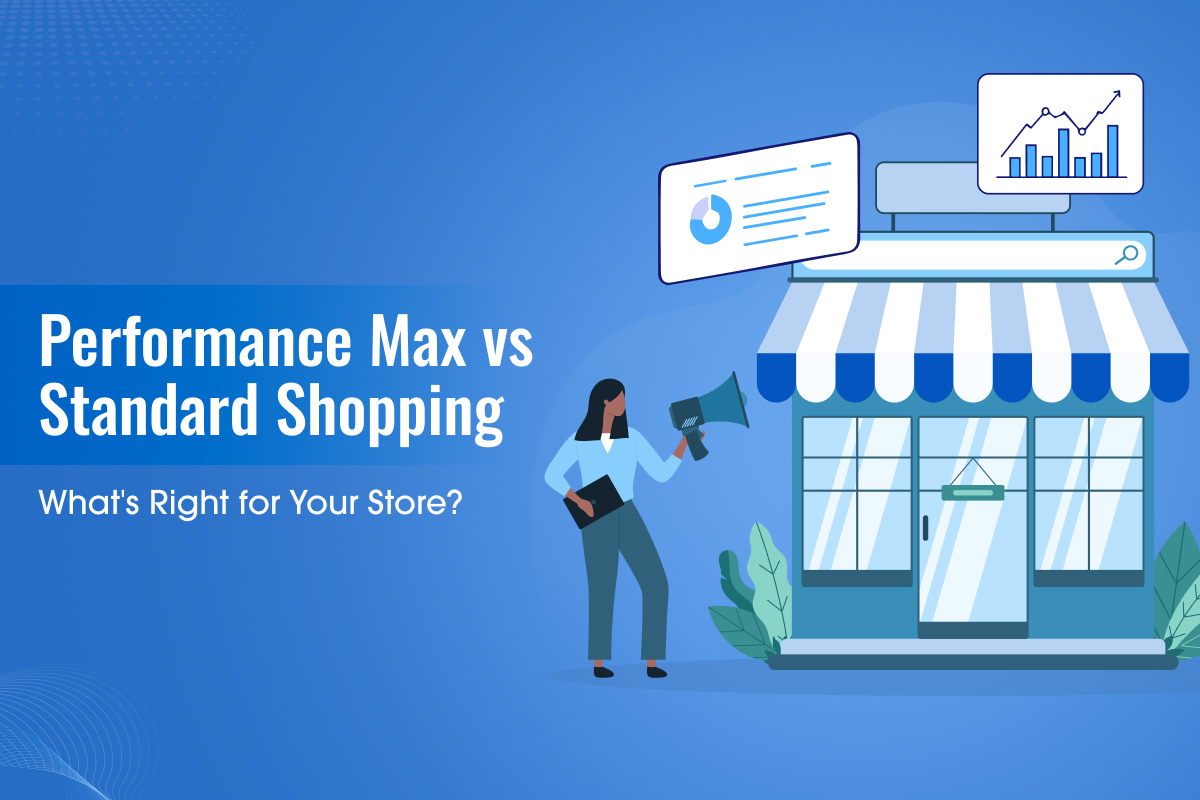
If you’re choosing between Google Shopping campaign types, you’re not alone. As an SEO agency in India, clients often ask whether to use Performance Max or stick with Standard Shopping. Google has been nudging advertisers toward Performance Max. This push has left many store owners and paid-media teams uncertain.
So in this article, we give you a clean, side-by-side view. You’ll get the facts and trade-offs. We will guide you to the path that fits your budget, catalog size, and appetite for automation.
Understanding the Two Campaign Types
Both campaign types promote products from your Google Merchant Center feed. Yet they behave very differently. Below is a short primer to set the stage before we compare them point by point.
What Is Standard Shopping?
Standard Shopping is the classic Shopping campaign. It pulls products from your Google Merchant Center and shows product listing ads (PLAs) on search and the Shopping tab.
Advertisers set product groups, choose bids, add negative keywords, and see search term data. This makes this format highly transparent and controllable. Standard Shopping is widely used when you need predictable spend and clear reporting.
What Is Performance Max?
Performance Max (PMax) is Google’s AI-first, omnichannel campaign type introduced in 2021. One campaign can run ads across Search, Display, YouTube, Gmail, Maps, Discover, and Shopping. It uses Smart Bidding, audience signals, and asset groups to mix creatives and placements.
Google’s systems make many targeting and placement decisions for you. PMax aims to find conversions across the full Google network without manual placement control.
Performance Max vs. Standard Shopping — A Head-to-Head Comparison
To decide, you must weigh control against scale. Here’s a focused comparison of the most consequential differences.
Control and Transparency
Standard Shopping wins for visibility. You can create product groups, set bids by product, inspect search terms, and use negative keywords. This level of control helps protect margins on expensive items.
PMax historically acted like a black box. It gave limited search-term data and little placement-level detail. Recent updates have improved placement visibility, but many reporting gaps remain. If you need to see exactly which searches triggered a product ad, Standard Shopping is the safer choice.
Teams that want hands-on campaign tuning and clear signals benefit from this. If you prefer full automation, PMax might be acceptable.
Reach and Inventory Coverage
PMax runs everywhere Google serves ads. This means it can catch customers at the top of the funnel and bring them to purchase later. Standard Shopping is focused on the Shopping tab and search results. It’s a bottom-of-funnel format that captures high-intent queries.
For brands seeking broad omnichannel reach, PMax expands inventory coverage. For tight, search-driven acquisition, Standard Shopping keeps things lean and direct.
Bidding and Budget Efficiency
Standard Shopping gives you options: manual CPC or automated bidding like Target ROAS with predictable constraints. This makes spend pacing and SKU prioritization clearer. PMax only uses Smart Bidding. Its algorithms can run fast during the learning window. Budget allocation across products is opaque.
If you have a few hero SKUs, Standard Shopping helps protect them. If you have thousands of SKUs and want the system to allocate automatically, PMax can save time, but at the cost of short-term volatility.
Reporting and Optimization Levers
Standard Shopping provides search term reports, auction insights, and device-level bidding adjustments. You can exclude queries, test bids per product group, and troubleshoot quickly.
PMax primarily supplies asset-level performance and aggregated signals. It restricts negative keywords and offers fewer levers for granular fixes. This makes diagnosing poor performance harder. Recently, Google added a “where ads showed” view for PMax, which improves transparency but does not fully replace granular search-term data yet.
Performance During the Learning Phase
PMax needs data to train its models. Expect a longer learning phase, often several weeks, before performance stabilizes. This can be costly if your conversion volume is low.
Standard Shopping typically returns useful signals faster and scales more predictably with modest budgets. If your store has limited conversions per week, PMax may struggle to optimize effectively.
When Should You Choose Performance Max?
If your situation matches a few clear traits, PMax is a strong candidate. Here are some of the strong reasons for you to choose PMax.
You Have a Large Product Catalog
PMax handles big feeds well. If you manage thousands of SKUs, PMax can surface items across many surfaces without manual campaign proliferation. This reduces management overhead and can find pockets of demand that manual targeting would miss.
Tip: Ensure your Merchant feed is clean. Feed quality drives PMax learning.
You Are Scaling an Established Account
PMax performs best when it has historical conversion data. If your account already records stable conversions and you’ve run Search or Shopping campaigns successfully, PMax’s AI has signals to learn from. Established accounts see faster gains and better allocation.
You Want Omnichannel Reach Without Managing Multiple Campaigns
PMax bundles placements. If you lack bandwidth to run separate Display, Shopping, and YouTube campaigns, PMax simplifies the stack. It can test multiple creative variations and placements at scale. This matters for brands that want ad coverage across the customer journey with less manual effort.
Many businesses working with a digital marketing company use PMax for this reason. It reduces complex campaign management while still hitting cross-channel targets.
When Should You Stick With Standard Shopping?
Standard Shopping still has clear wins. Use it when you need predictability and surgical control.
You Need Granular Control Over Spend
Small and mid-sized advertisers often can’t tolerate the waste of a long learning phase. If you have a tight daily budget, Standard Shopping lets you allocate spend to priority products and control bids precisely. Use it when each click needs to be accounted for.
You Are Promoting a Niche or High-Ticket Product
High-ticket items need careful bidding. A single misallocated click can erode margins. Standard Shopping lets you protect profitability through exact match to product queries, negative keywords, and bid rules. For niche SKUs with limited search volume, manual control beats algorithmic scaling.
A professional digital marketing company often recommends running Standard Shopping on your core SKUs while testing PMax on the rest.
You Are Testing or Troubleshooting Campaigns
Troubleshooting is simpler when you can isolate variables. Standard Shopping lets you switch bids, pause product groups, and test landing pages in a controlled way. If you suspect feed issues, incorrect tax or shipping settings, or mismatched landing pages, Standard Shopping speeds diagnosis.
Practical Hybrid Strategy
You don’t need to choose just one. Many experienced advertisers run both. Here’s a short, practical approach:
- Keep Standard Shopping for priority SKUs. Protect high-margin or strategic items with dedicated bids and negative keywords.
- Run PMax to capture broad demand and support lower-margin, high-volume SKUs. Let it hunt for conversions across channels.
- Monitor overlap. Use experiments or Google’s A/B tools to ensure campaigns are not cannibalizing each other. Google provides experiment tools to compare Standard Shopping vs PMax directly.
Track ROAS, CPA, and conversion volume per SKU. If PMax consistently outperforms in certain categories, consider shifting the budget. If transparency matters for regulatory or reporting reasons, favor Standard Shopping.
Stop Guessing — Let the Right Strategy Work for Your Business
There’s no single winner. Each format serves a purpose. PMax gives reach and automation. Standard Shopping gives control and clear signals. Your choice should follow budget size, catalog scale, conversion history, and tolerance for algorithmic control.
A common and practical path is to run both: use PMax for scale and broader reach, and use Standard Shopping to protect priority SKUs and maintain clear reporting. This balance produces steady growth without losing sight of margins.
If you want help designing that balance, talk to the team at Indian SEO Company. We audit feeds, set up controlled experiments, and align bids to business goals. Our PPC services include shopping campaign setup, feed optimization, and campaign audits to determine which mix fits your store. Connect for a free consultation or campaign audit and get a clear plan for your account.
Ready to stop guessing and start testing with a partner who knows Google Shopping? Reach out to the Indian SEO Company PPC team for a free audit and tailored recommendation. Our SEO agency in India helps you map a plan that balances reach and control while protecting margins and ROI.